
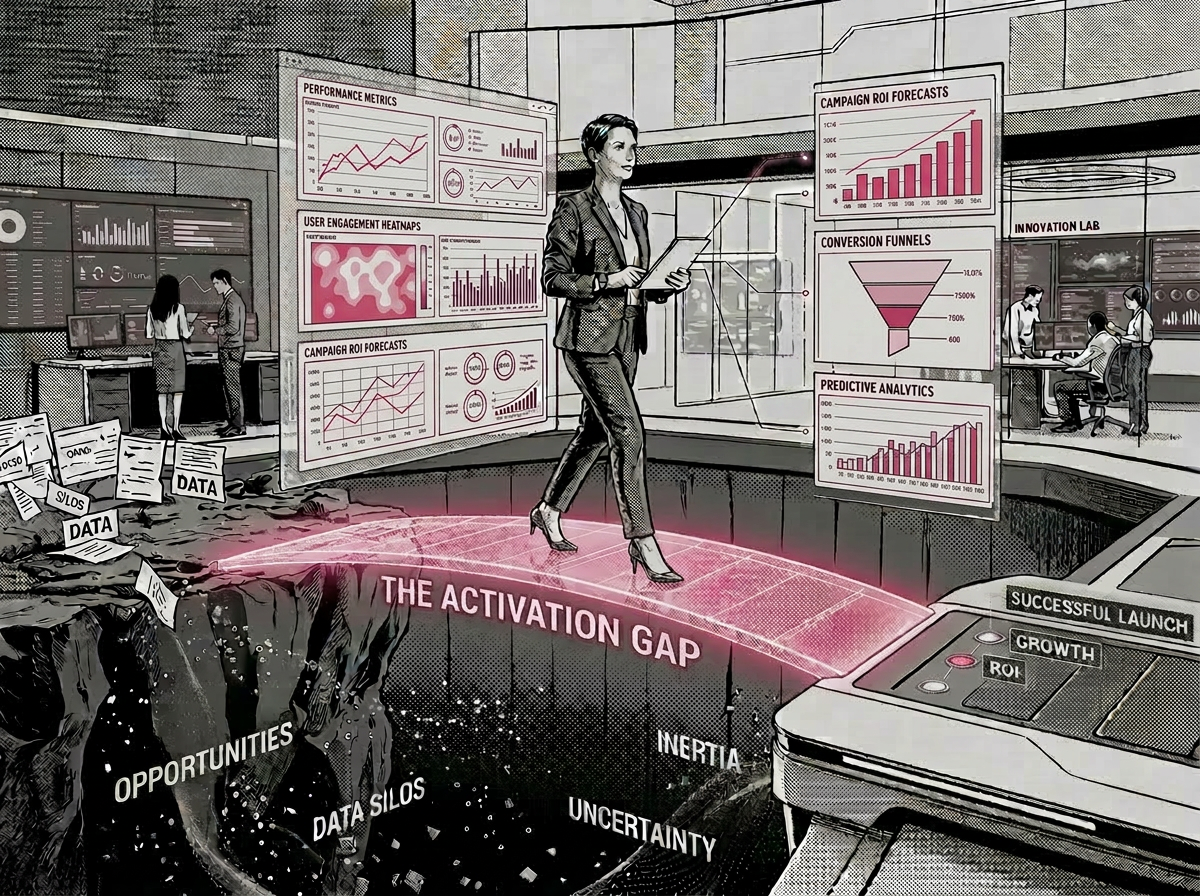
Executive Takeaway: Organizations have spent decades improving their ability to understand what happened, predict what is likely to happen, and prescribe what should be done next. But many still struggle with the most important step: turning recommendations into aligned, accountable, and measurable action. The next evolution in analytics and decision intelligence is not simply better dashboards, forecasts, models, or AI-generated recommendations. It is Decision Activation: the missing layer that reduces the distance between insight and execution by combining predictive signals, prescriptive recommendations, governance logic, stakeholder context, success criteria, and LLM-assisted communication into operational workflows. AI’s greatest value will not come from replacing human judgment. It will come from helping organizations explain, scrutinize, align around, and execute better decisions under uncertainty. The future belongs to organizations that can understand what happened, predict what may happen next, prescribe the right actions, and activate execution.
From Analytics to Activation
For decades, organizations have invested heavily in systems designed to answer three fundamental questions. First, what happened? Second, what is likely to happen? Third, what should we do? These questions underpin the familiar progression from descriptive analytics to predictive analytics and, more recently, prescriptive analytics. Entire industries have emerged around helping organizations collect data, build forecasts, and generate recommendations.
Yet despite all of this progress, a frustrating reality remains. Organizations possess more data than ever before. They have dashboards, reports, machine learning models, forecasting engines, and increasingly, AI assistants. But recommendations do not automatically create action. Insight does not guarantee alignment. Prediction does not ensure execution.
Many organizations have become exceptionally good at generating information while remaining surprisingly inconsistent at turning that information into decisions.
This reveals a missing layer in the traditional analytics maturity model.
The future of decision intelligence is not simply about describing, predicting, and prescribing. It is about activating.
The progression becomes remarkably simple:
Describe → Predict → Prescribe → Activate
The first three layers help organizations understand reality and identify the best course of action. The fourth layer ensures that action actually occurs.
The Missing Layer in Modern Analytics
Most organizations begin with descriptive systems. Platforms such as HubSpot, Salesforce, SAP, Workday, and ServiceNow are designed to capture events and transactions. They tell us what happened, when it happened, and who was involved. A CRM system may tell us that an opportunity is worth $4.75 million, that it sits in a particular sales stage, and that it has fifty-two days remaining before its expected close date. This information is valuable because it creates a shared understanding of reality. However, it is not a decision. It is merely a description of what exists.
The next step is prediction. This is the domain of business intelligence, forecasting, machine learning, and statistical modeling. Instead of asking what happened, organizations begin asking what is likely to happen. Predictive systems estimate close probabilities, forecast revenue, identify risks, and anticipate future outcomes. A model may tell us that a deal has a twenty-five percent probability of closing or that a project is likely to miss its target date. These insights are tremendously valuable because they transform historical observations into forward-looking expectations.
More mature organizations eventually move into prescriptive systems. This layer answers a different question altogether: what should we do? Analytics identifies possibilities. Decision systems recommend actions. A predictive model might tell us that a deal has a twenty-five percent chance of closing. A prescriptive system goes further and recommends a specific intervention. It may suggest running a technical validation sprint within the next ten business days, estimate the expected improvement in conversion probability, identify the factors driving the recommendation, and define the metrics that will be used to determine success.
This is where most organizations believe the journey ends. In reality, it is where the most important work begins.
Why Analytics Stops Short of Decisions
The traditional architecture of modern analytics is surprisingly simple. Data flows into analytical systems, analytical systems produce forecasts and recommendations, and those recommendations are presented to humans. The assumption is that people will naturally convert information into action.
In practice, that conversion process is often informal and inconsistent. Executives are presented with dashboards, probabilities, forecasts, reports, and risk scores and are expected to somehow translate them into decisions. That translation process is typically influenced by experience, organizational politics, intuition, incentives, and competing priorities. Two leaders can look at the exact same information and arrive at completely different conclusions.
The result is a process that is difficult to explain, difficult to audit, and nearly impossible to improve systematically.
This gap between recommendation and execution is one of the most overlooked challenges in modern organizations. A recommendation that is not trusted will never be executed. A recommendation that is not understood will be ignored. A recommendation that cannot survive scrutiny will struggle to gain organizational alignment. The existence of a recommendation does not guarantee action. In many cases, it simply creates another item for debate.
Organizations have spent years investing in better analytics. Very few have invested in better decision activation.
The Rise of Decision Activation
This is why I believe the next frontier is not prescriptive analytics. It is activation.
Activation focuses on a fundamentally different set of questions. Can we act? Should we act now? What happens if we do nothing? What trade-offs are involved? Who owns execution? How will we know if the recommendation worked?
These questions rarely appear in dashboards, yet they are often the questions executives care about most.
The purpose of an activation layer is to reduce the distance between a recommendation and an executed decision. It exists to create alignment, trust, accountability, and measurable action. While predictive systems estimate outcomes and prescriptive systems recommend interventions, activation systems help organizations operationalize those recommendations.
This is where many of the most exciting opportunities for AI begin to emerge.
Contrary to popular belief, I do not believe AI’s greatest value lies in making decisions on behalf of humans. Its greatest value lies in helping organizations activate decisions more effectively. AI can explain recommendations, tailor communication to different stakeholders, identify trade-offs, surface assumptions, generate execution plans, monitor progress, and continuously measure outcomes. In other words, AI becomes an activation engine rather than a decision maker.
Imagine a recommendation accompanied by a Decision Readiness Score that quantifies whether sufficient evidence exists to act. Imagine seeing the Cost of Inaction alongside the recommendation, showing the expected value that may be lost by waiting another thirty days. Imagine stakeholder lenses that allow sales, marketing, finance, operations, and executive leadership to view the recommendation through their own perspectives. Imagine decision pivots that highlight where stakeholders agree and where they disagree. Imagine success criteria that clearly define how the organization will determine whether the recommendation worked.
These capabilities do not replace judgment. They support it.
Most importantly, they help organizations move from recommendation to execution.
Building the Next Generation of AI-Assisted Decision Systems
Much of today’s excitement around generative AI is focused on creating systems that can generate answers. Unfortunately, many AI architectures attempt to compress everything into a single step. Data is provided to a large language model, and the model is asked to generate a recommendation. In that architecture, the same system is simultaneously interpreting evidence, making decisions, and explaining decisions. The reasoning process becomes opaque. Governance becomes difficult. Trust becomes fragile.
A more robust architecture separates these responsibilities.
In the approach we have been developing, operational systems feed a governed warehouse. Predictive models generate signals. Retrieval systems provide supporting evidence. A Decision Packet assembles the facts, recommendations, assumptions, constraints, and governance context. Only then does the language model become involved. Its role is not to decide. Its role is to explain, summarize, personalize, and activate.
This distinction is critical because it preserves transparency and accountability. The recommendation is determined before the AI becomes involved. The AI helps stakeholders understand the recommendation, align around it, and ultimately act upon it.
For years, organizations have invested in technologies designed to describe reality. More recently, they have invested in technologies designed to predict the future. Today, many are racing toward systems capable of prescribing actions. But the next frontier is not prediction. It is activation.
The organizations that generate the greatest value from AI will not necessarily be those with the largest models, the most dashboards, or the most sophisticated algorithms. They will be the organizations that consistently transform recommendations into aligned, accountable, and measurable action.
That requires more than analytics.
It requires a decision architecture.
One that can describe reality, predict outcomes, prescribe actions, and activate execution.
Describe. Predict. Prescribe. Activate.
I believe that is where the future of decision intelligence is headed.

About the Author
Robb is the President and Principal Decision Intelligence Architect at Scope Analytics, where he advises Revenue, Marketing and Executive leaders on designing decision-driven analytics, judgment architecture, and AI-enabled decision systems.

Learn more: https://www.scopeanalytics.com
Leave a Reply