
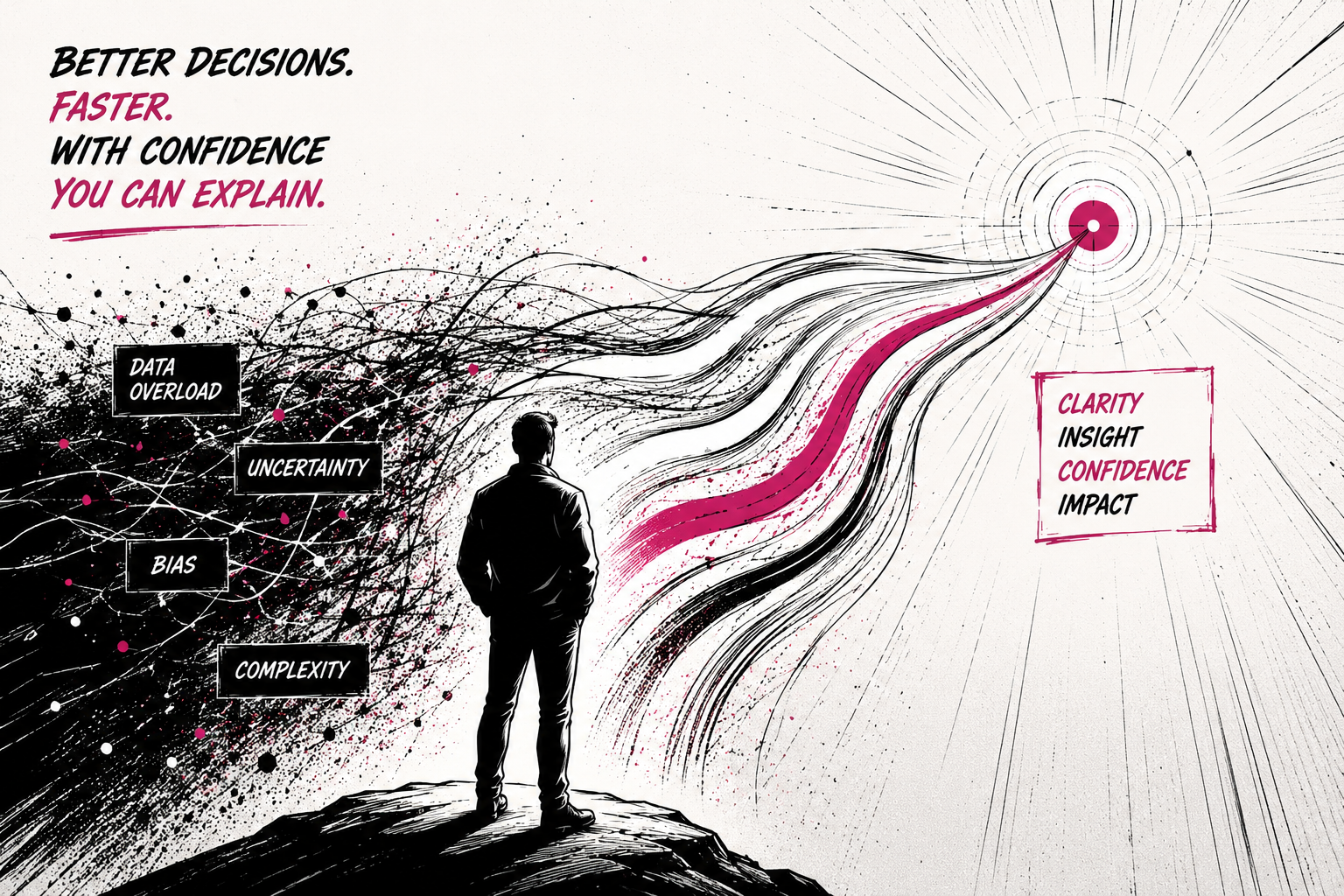
Executive Takeaway: Organizations are racing to deploy AI agents, autonomous workflows, and orchestration frameworks—but many are accelerating execution without improving the quality of the underlying decision systems themselves. AI does not fix broken decision environments. It amplifies them. The next evolution beyond today’s Agentic AI hype cycle will be AI-Assisted Decision Intelligence Workflows: governed systems that combine analytics, probabilistic models, contextual retrieval, governance logic, human judgment, and LLM-assisted communication into operational decision environments designed to improve how organizations prioritize, escalate, and execute decisions under uncertainty. The future advantage will not come from deploying more AI. It will come from operationalizing better decisions.
The Problem Isn’t a Lack of AI
The enterprise world is rapidly embracing Agentic AI. Gartner’s 2026 Hype Cycle for Agentic AI1 suggests that many of these technologies are already approaching — or sitting directly at — the Peak of Inflated Expectations. Organizations are racing toward AI agents, orchestration frameworks, multi-agent systems, AI assistants, and autonomous workflows. The excitement is understandable. For the first time, businesses can envision software systems capable not only of generating content, but also coordinating actions, interacting across systems, and autonomously executing operational tasks.
But beneath the excitement sits a more fundamental problem.
Most organizations are layering AI onto existing workflows without redesigning how decisions are made, prioritized, governed, or operationalized.
Most organizations are layering AI onto existing workflows without redesigning how decisions are made, prioritized, governed, or operationalized. AI is being inserted into fragmented systems, heuristic processes, disconnected analytics environments, and unclear escalation paths. In many cases, organizations are accelerating execution without first improving the quality of the underlying decision architecture itself.
This creates a dangerous outcome: faster systems do not necessarily produce better decisions. In fact, poorly governed AI systems may simply amplify existing organizational weaknesses at scale.
AI does not fix broken decision systems. It amplifies them.
That is why I believe the next major evolution beyond today’s AI hype cycle will not simply be better AI agents. It will be the emergence of AI-Assisted Decision Intelligence Workflows.
From AI Automation to Decision Intelligence
Most AI conversations today focus on what systems can do autonomously. Decision Intelligence focuses on how organizations structure, govern, and operationalize decisions under uncertainty. These are fundamentally different problems.
Agentic AI automates actions. Decision Intelligence governs decisions.
As AI systems become more autonomous and interconnected, organizations increasingly need explicit decision structures defining:
- what objectives matter
- which signals are trusted
- where escalation boundaries exist
- how trade-offs should be evaluated
- and when human judgment must remain in the loop
Without these structures, organizations risk creating highly capable execution systems operating against poorly designed decision environments.
This is where AI-Assisted Decision Intelligence Workflows become important.
An AI-Assisted Decision Intelligence Workflow is not simply a chatbot or orchestration layer. It is a governed operating model for embedding AI into how decisions are framed, prioritized, escalated, evaluated, and executed across the enterprise.
Instead of asking: “How do we deploy AI agents?” organizations should increasingly ask:
“How should we redesign decision systems for AI-assisted execution?”
That shift changes everything.
Redesigning Workflows Around Governed Decisions
In practice, this means moving beyond isolated AI assistants toward governed workflows that integrate:
- probabilistic models
- enterprise data
- retrieved contextual evidence
- intervention logic
- governance policies
- human review structures
- and LLM-assisted translation
The goal is not merely automation. The goal is decision-ready action.
This distinction is particularly important because many organizations remain trapped in what I often describe as “analytics without operational consequence.” Dashboards proliferate. KPIs expand. Insights accumulate. Yet organizations still struggle to consistently prioritize the right actions under real-world uncertainty.
Adding AI on top of these systems does not solve the underlying problem.
The opportunity is not simply to automate workflows. It is to redesign workflows around governed decision systems.
That is the philosophy behind the work I have been building around Decision Intelligence, Judgment Architecture, Decision Contracts, and AI-Assisted Decision Intelligence Workflows.
At a practical level, this involves creating explicit structures that govern:
- decision objectives
- trusted signals
- intervention thresholds
- escalation logic
- economic trade-offs
- and operational accountability
What This Looks Like in Practice
One example is a workflow I recently demonstrated for prioritizing B2B pipeline interventions. The system combines probabilistic scoring, enterprise context retrieval, intervention modeling, governance logic, and LLM-assisted communication into a single governed workflow designed to answer a fundamentally difficult executive question:
“Where should we invest additional resources to create the greatest measurable impact?”
Rather than merely surfacing data, the workflow estimates:
- Expected Pipeline Value (EPV)
- Incremental Realizable Value (IRV)
- expected close-rate lift
- intervention saturation
- and marginal economic impact
The workflow then operationalizes those insights through governed recommendations, decision packets, and human-in-the-loop review structures.
Increasingly, organizations must also address what happens after a decision is made. Producing a recommendation is only part of the challenge. Teams must still align stakeholders, sequence actions, evaluate trade-offs, monitor execution risks, and adapt as conditions change. As AI-assisted decision systems mature, a complementary Activation Layer will emerge to help translate governed decisions into coordinated execution plans while preserving transparency, accountability, and human oversight.
In that sense, AI-Assisted Decision Intelligence Workflows are not simply about making better decisions. They are about creating a governed bridge between decision quality and execution quality. Organizations that master both will be better positioned to realize measurable business outcomes from AI investments.
Importantly, the demo itself intentionally exposes many of the workflow components—Decision Contracts, scoring logic, retrieval layers, governance structures, and orchestration patterns—not because end users would normally see them, but because the larger goal is to illustrate how AI-Assisted Decision Intelligence Workflows are constructed.
This is not simply “AI added to sales.”
It is workflow redesign around governed decision systems.
And I believe this broader shift will become increasingly important as organizations move beyond the current Peak of Inflated Expectations surrounding Agentic AI.
The next competitive advantage will not come from simply deploying more AI agents.
It will come from building organizations capable of governing, prioritizing, and operationalizing AI-assisted decisions more effectively than their competitors.
At Scope Analytics, this is precisely the focus: helping organizations move through the inevitable Trough of Disillusionment and onto the Slope of Enlightenment faster than their competitors by redesigning workflows around governed Decision Intelligence systems.
That requires more than AI.
It requires Decision Intelligence.

About the Author
Robb is the President and Principal Decision Intelligence Architect at Scope Analytics, where he advises Revenue, Marketing and Executive leaders on designing decision-driven analytics, judgment architecture, and AI-enabled decision systems.

Learn more: https://www.scopeanalytics.com
Leave a Reply