
Executive Decision
-

Organizations have advanced in analytics but often struggle to implement recommendations into actionable decisions. The future of decision intelligence lies in “Decision Activation,” which bridges the gap between insight and execution by promoting stakeholder alignment, accountability, and measurable actions, ensuring effective decision-making under uncertainty.
-
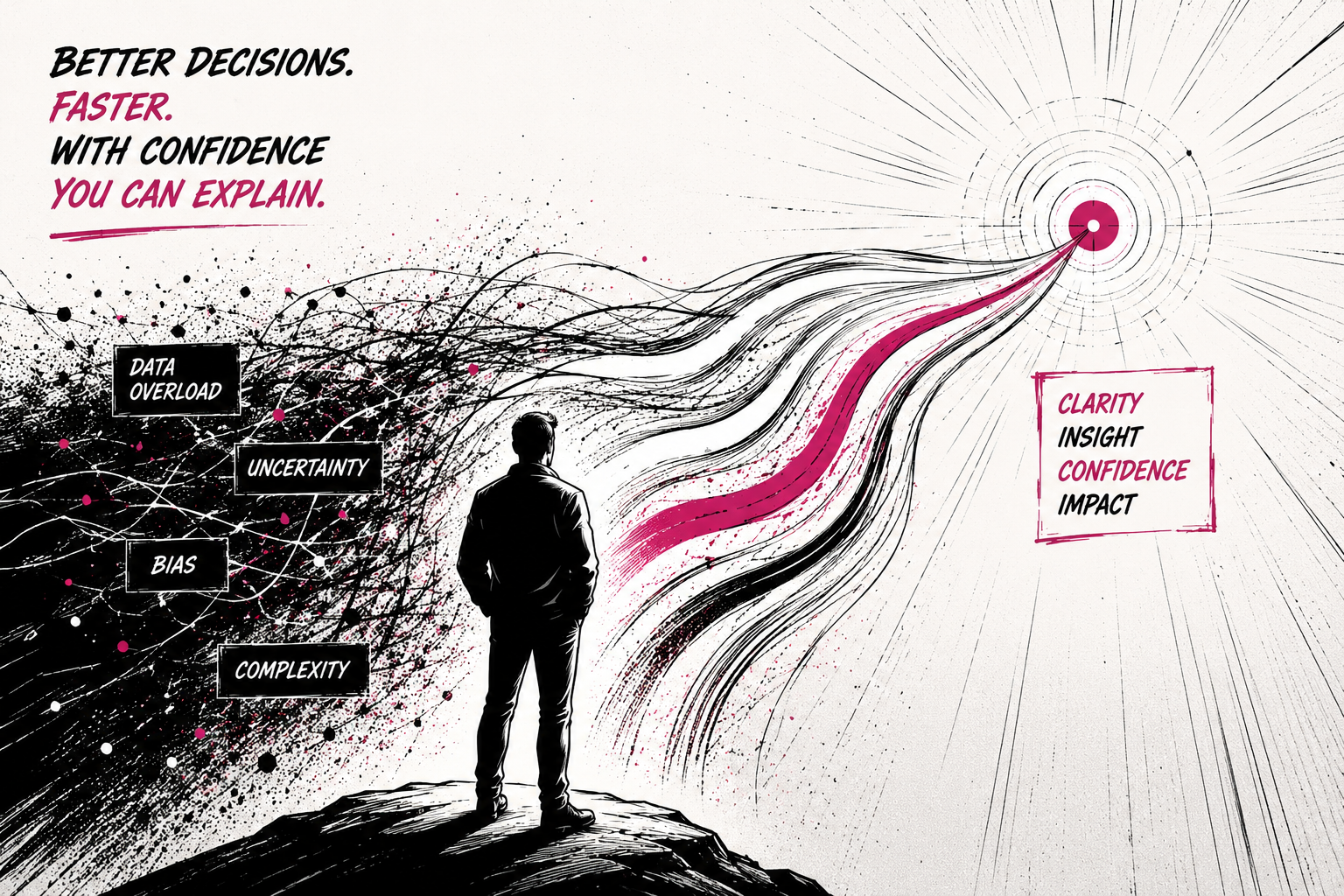
Organizations are rapidly adopting AI technologies, driven by excitement around automation. However, many overlook the need for redesigning decision-making processes, leading to ineffective systems. The future lies in AI-Assisted Decision Intelligence Workflows, which emphasize governance, prioritized actions, and collaboration between human judgment and AI, ensuring better operational outcomes.
-

Organizations investing in AI often prioritize infrastructure but overlook a critical question: what decision is being improved? This leads to a weak approach that operationalizes conversation rather than intelligence. The concept of a Decision Contract can transform AI from a vague assistant to a governed, decision-oriented system, ensuring effective judgment and measurable economic actions.
-

Effective pipeline management is not a function of volume, but of how probabilistic outcomes respond to intervention. Pipeline behaves as a distribution of potential outcomes—each opportunity varying in likelihood, timing, and responsiveness. By identifying high-elasticity opportunities—where incremental effort can still meaningfully shift the probability of conversion within the planning window—organizations can generate disproportionate impact. This…
-

Executive Takeaway: Decision Debt exists in every organization—it’s only a question of degree. It exposes the hidden costs of unclear or poorly grounded choices: confidence built on assumptions that becomes misdirection, wasted effort, delay, rework, and lost trust. While the metrics and framework introduced is conceptual, it helps leaders see where risk hides—thin evidence, heavy…
-

Executive Takeaway: Markov models matter because they don’t just show where customers or deals are today—they reveal how groups are likely to move tomorrow—toward growth, retention, or churn. They reveal not just the what (likelihood of churn, revenue forecast) but the pathways—how customers and deals actually flow over time. That creates runway for action, giving…
-

In ‘The Executive Decision Series,’ I delve into key decision science concepts that empower leaders to make smarter, data-driven decisions. Today, we focus on Monte Carlo Simulations—their importance, how they function, and how they can be applied to campaign forecasting through a clear and practical marketing example. Executives should treat forecasted values with skepticism unless…
-

In ‘The Executive Decision Series,’ I delve into key decision science concepts that empower leaders to make smarter, data-driven decisions. Today’s focus is on enhancing the decile table by incorporating critical financial metrics—Revenue, Cost per Acquisition (CPA), and Return on Investment (ROI). This extension bridges the gap between predictions and profitability, enabling leaders to align…
-

In ‘The Executive Decision Series,’ I explore key decision science concepts that empower leaders to make smarter, data-driven decisions. Today’s focus is on leveraging decile tables to rank and segment audiences using predictive model scores. In part two, we’ll take this further by calculating ROI per segment to optimize marketing spend and drive maximum impact.
-

This post explains how saturation curves empower executives to allocate marketing budgets more effectively by identifying the optimal spend level for each channel, avoiding wasted investment, and maximizing ROI.