
Educational
-
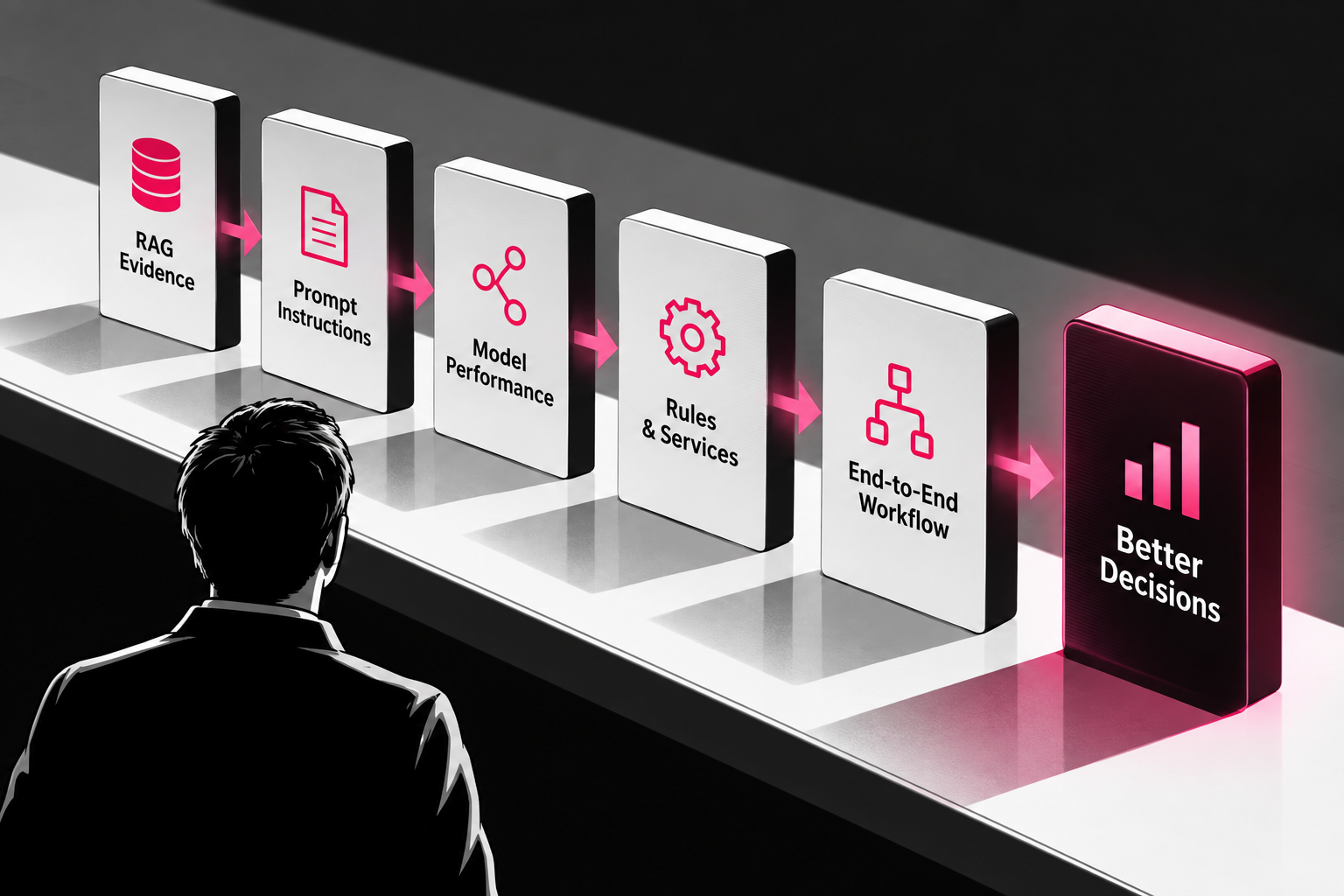
How do you test an enterprise AI system when performance is distributed across a chain of interdependent components? In this post, I outline a layered evaluation framework for RAG, prompts, GenAI models, deterministic rules, and end-to-end workflows—using a Decision Contract to define what “good” looks like. The goal is not a single AI accuracy score,…
-

Decision Science is evolving into AI Engineering—not by replacing models with LLMs, but by bringing predictive signals, RAG, enterprise knowledge, business rules, and human judgment together inside AI-assisted decision workflows. The tools have changed. The objective hasn’t: better decisions.
-

Organizations investing in AI often prioritize infrastructure but overlook a critical question: what decision is being improved? This leads to a weak approach that operationalizes conversation rather than intelligence. The concept of a Decision Contract can transform AI from a vague assistant to a governed, decision-oriented system, ensuring effective judgment and measurable economic actions.
-

Executive Takeaway: Decision Debt exists in every organization—it’s only a question of degree. It exposes the hidden costs of unclear or poorly grounded choices: confidence built on assumptions that becomes misdirection, wasted effort, delay, rework, and lost trust. While the metrics and framework introduced is conceptual, it helps leaders see where risk hides—thin evidence, heavy…
-

Executive Takeaway: Markov models matter because they don’t just show where customers or deals are today—they reveal how groups are likely to move tomorrow—toward growth, retention, or churn. They reveal not just the what (likelihood of churn, revenue forecast) but the pathways—how customers and deals actually flow over time. That creates runway for action, giving…
-

My latest post discusses optimizing Marketing spend using reinforcement learning (RL) and an LLM as a meta-controller—an approach we term Agentic-AI. It details creating a custom RL environment for managing multiple Marketing channels and describes how the LLM meta-controller orchestrates the overall learning process. Rather than making spend decisions directly, the LLM guides iterative training,…
-

My latest post explores using a large language model (LLM) to directly control a reinforcement learning (RL) environment for optimizing Marketing spend. The LLM actively makes decisions step by step. Unlike typical RL applications, this setup allows real-time interaction and showcases the LLM’s reasoning process while determining optimal actions.
-

There is no excerpt because this is a protected post.
-

Check out my latest blog post, where I set up a simple scenario to show how a reinforcement learning (RL) agent finds the sweet spot in marketing spend—laying the groundwork for Agentic AI. Whether you’re curious about RL fundamentals or integrating LLMs, this mini use case offers valuable insight into the inner workings of RL…